Thursday, 24 March 2022

Building Material (Concrete)

 πŸ‘‰ Classification of Concrete

 (a) Based on Bulk density

     Extra light weight ⟶ < 500 kg/m3

     Light weight ⟶ 500 - 1800 kg/m3

     Dense weight ⟶ 1800-2500 kg/m3

    Super heavy weight ⟶ > 2500 kg/m3

(b) Based on Strength

   Low strength concrete ⟶ < 20 N/mm2

   Medium strength concrete ⟶ 20-40 N/mm2

   High strength concrete ⟶ > 40 N/mm2

πŸ‘‰ Curing Temperature of Concrete : 5 to 28 degree centigrade

πŸ‘‰Maturity of Concrete   

  • The strength of concrete depends on both period of curing (i.e age) and temperature during curing.
  • Maturity of Concrete = (Period x temperature)
  • It is measured in °C hours or °C days.
  • The maturity of concrete is defined as the summation of product time and temperature.
  • Maturity = Ξ£ (time x temperature)
πŸ‘‰Strength of Concrete 

(a) Compressive Strength Test

  • Test Specimen : 150 x 150 x 150 mm cubes 
                                  : Cylinder of 150 mm diameter and 300 mm height

  • Test specimens are stored at a temperature of 27 ± 3 °C at 90 % humidity for 24 ± 1/2 hour from the time of addition of water to the dry ingredients.
  • 7 days strength of concrete should be at least 2/3 of 28 day strength of concrete.
  • Average of the three values is taken as the compressive strength of concrete, provided the individual variation is not more than ± 15 % of the average.
  • Cube Strength = 1.25 x cylinder strength
(b) Flexural Tensile Strength Test ( Modulus of Rupture Test)

  • Direct measurement of tensile strength is difficult.
  • Indirect test for assessing the tensile strength of concrete.
  • Concrete is filled in the mould size 150 x 150 x 700 mm
Modulus of Rupture = p.l / bd2  when a > 200 mm

                                = 3pa / bd2   when 200 mm > a > 170 mm


Here,

    a = distance between the line of fracture and the nearest support, measured on the centre line of the tensile side of the specimen (cm)

b and d is measured width and depth of specimen respectively

l = length of the span on which the specimen is supported (cm)

p = maximum load applied to the specimen


(c) Split Tensile Strength Test

  • Standard test cylinder of concrete specimen of 300 mm x 150 mm diameter is placed horizontally between the loading surfaces of compression testing machine
 

                   Split Tensile Strength (Οƒ ) = 2P / Ο€DL

Where, P = Applied load

            D = Diameter of the cylinder

            L = Length of the cylinder


πŸ‘‰ Cube Strength > Cylinder Strength > Modulus of Rupture > Split Tensile Strength

πŸ‘‰ Generally tensile strength of concrete is 10 % of its compressive strength


                                                Happy Learning

                             Please follow me on talktorashid.blogspot.com


Tuesday, 22 March 2022

Fluid Mechanics

 Do You Know?

πŸ‘‰          Device                               Measurement

            Venturimeter                           rate of flow

             Flow nozzle                           rate of flow

             Orifice meter                          rate of flow

             Bend meter                             rate of flow

             Rotameter                               rate of flow

               Pitot tube                               Velocity of flow

         Hot wire anemometer                 Air & Gas velocity

         Current meter                             Velocity in open channel

πŸ‘‰Classification of Jump

Hydraulic Jump (HJ):  Hydraulic jump is an example of steady rapidly varied flow(RVF)

Hydraulic jump occurs when a supercritical stream meets a Subcritical stream of sufficient depth.

πŸ‘‰Classification of jump 

     Type                     Initial Froude Number (F1)                 EL/E1 (%)

Undular Jump                           1-1.7                                               0

Weak Jump                             1.7-2.5                                            5 -18

Oscillating jump                     2.5-4.5                                            18-45

Steady jump                              4.5-9                                             45-70

Strong Choppy                          > 9.0                                               > 70


Sunday, 20 March 2022

Engineering Hydrology

 Do you Know?

πŸ‘‰Evaporation Measurement

(a) Using Evaporimeter Data

(b) Empirical Evaporation Equation

(c) Analytical Methods

πŸ‘‰Types of Evaporimeter

(a) Class A Evaporation Pan (US Weather Bureau)

(b) ISI Standard Pan (Used in India)

(c) Colorado Sunken Pan 

(d) US Geological Survey Floating Pan

πŸ‘‰     Lake Evaporation = Pan coefficient x pan evaporation

πŸ‘‰          Types of Pan                   Average value               Range

            Class A Land Pan                    0.70                           0.60-0.80

        ISI Pan (Modified Class A)         0.80                           0.64-1.10

        Colorado Sunken Pan                  0.78                           0.75-0.86

        US GS Floating Pan                     0.80                          0.70-0.82

πŸ‘‰Empirical Formulae

Empirical formulae are based on Dalton's Law.

(a) Meyer's Formula

πŸ‘‰Analytical Methods

(a) Water-Budget method

(b) Energy-balance method

(c) Mass-transfer method

πŸ‘‰Measurements of Actual Evapotranspiration

(a) Phytometer (Measures only transpiration)

(b) Lysimeter 

(c) Field experimental plots

πŸ‘‰Estimation of Potential Evapotranspiration 

(a) Penman's Equation

Based on combination of the energy-balance and mass-transfer approaches.

(b) Blanney-Criddle Formula

πŸ‘‰Measurement of Infiltration

(a) Flooding type infiltrometer

(b) Rainfall simulator

πŸ‘‰Empirical Infiltration Equations

(a) Green-Ampt method

(b) Horton Infiltration Equation

(c) Huggins-Monka Equation

(d) Soil Conservation Service Practice

(e) Antecedent Precipitation Method

πŸ‘‰Horton's Equation


                                                               HAPPY LEARNING 


                                         Please follow me on talktorashid.blogspot.com


Saturday, 19 March 2022

Building Material

 πŸ‘‰Classification of Tree

(a) Exogenous                               (b) Endogenous

⟶ Conifers (Soft Food) and Deciduous (Hard wood) are the types of Exogenous tree

πŸ‘‰Endogenous Tree 

  • Trees grow inwards
  • Example: Bamboo, Cane, Palm
πŸ‘‰Exogenous Tree 

  • Trees grow outwards
  • annual rings are used for predicting age of the tree
πŸ‘‰ Conifers (Evergreen trees)    

  • Trees yield softwood
  • Distinct annual rings
πŸ‘‰Deciduous or Broad leaf trees    

  • Do not show distinct annual rings
  • Trees yield hard wood
  • Example: Teak, Mahogany, Sheesham, Oak, Sal, Babool
πŸ‘‰ Difference between Softwood and Hardwood 

                                         Softwood                             Hardwood

Colour :                              Lighter                                  Darker

Growth:                              Faster                                    Slower

Weight:                              Lighter                                  Heavier

Density:                             Low                                       High

Annual rings:                     Distinct                                 Indistinct

Strength:                      Strong along the grains               Strong along and across the grains

Conversion:                         Easy                                     Difficult

Fire resistance:                    Poor                                     Moderate             

πŸ‘‰Detailed Cross sectional view of the trunk of an exogenous tree


(a) Pith

  • Innermost central portion or core of the tree called Pith or Medulla
  • As the plant becomes old, the pith dies up and decays.
(b) Heartwood (Truewood)

  • Inner annual rings surrounding the pith consistute the heartwood
  • Dark in colour
  • It indicates dead portion of tree
(c) Sap Wood (Alburnum or Xylem)

  • Outer annual rings between heart wood and cambium layer in the sap wood
  • It is usually light in colour and weight. It contains sap
(d) Cambium Layer

  • Cambium is very thin layer of tissue between sapwood and inner bark
(e) Inner Bark (Phloem)

  • It gives protection to the cambium layer from any injury
  • Phloem transports food from leaves to the roots
(f) Outer Bark (Cortex)

  • Outermost protective layer
  • Consist of cells of wood fibre
(g) Medullary Ray

  • Thin radial fibres extending from pith to cambium layer are known as medullary rays
  • Function of these rays is to hold the annual rings tightly together

Engineering Hydrology

πŸ‘‰ Do You Know

  • Tensiometer is used to measure capillary potential
  • Phytometer measures Transpiration
  • Lysimeter measures Evaporation
  • Infiltrometer measures Infiltration
  • Speed of wind is measured using Anemometer.
  • Average annual rainfall over whole of India is 119 cm.
πŸ‘‰Measurement of Precipitation

  • Rain Gauges
  • Pluviometer
  • Ombrometer
  • Hyetometer
πŸ‘‰ Types of Gauges

  • Non-Recording Gauges
(a) The Non-Recording gauge used in India as SYMONS Raingauge

  • Recording Gauges
(a) Tipping Bucket Type

(b) Weighing Bucket Type

(c) Natural Syphon Type

⟶ The record from Tipping bucket gives data on the intensity of rainfall

⟶Weighing bucket gives the idea of mass curve of rainfall (Plot of the accumulated rainfall against the elapsed time)

⟶In India Natural Syphon Type is adopted as Recording Rain Gauge.(This type of gauge gives a plot of the mass curve of rainfall) 

πŸ‘‰Inconsistency of Records

Some of the common cause of inconsistency of the records are:

  • Shifting of raingauge station to a new location
  • Neighborhood of the station undergoing a marked change
  • Replacement of old instrument by new one
  • Method of observation 
πŸ‘‰Inconsistency of record is corrected by using DOUBLE MASS CURVE technique. 

πŸ‘‰To convert the point rainfall values at various stations into an average value over catchment, several methods are available
(a) Arithmetical mean method
(b) Theissen- polygon method
(c) Isohyetal method

πŸ‘‰Accuracy: Isohyetal method > Theissen-polygon method > Arithmetical mean method

πŸ‘‰Frequency of Point Rainfall

The purpose of the frequency analysis of an annual series is to obtain a relation between the magnitude of the event and its probability of exceedence (P)

If the annual extreme series is arranged in descending order of magnitude and each position given a number 1 to N, 1 being given to Ist i.e largest value and N given to last value or least value. Then probability P of a rainfall at position m being equaled or exceeded is given by :

                             Method                                            Probability (P) 
                       
                             Weibull                                                 m/(N+1)
                             
                             California                                                m/N

                              Hazen                                                     (m - 0.5)/N

                              Blom                                                    (m-0.44)/(N+0.12)

πŸ‘‰ Probable Maximum Precipitation(PMP)

The probable maximum precipitation (PMP) is defined as the greatest or extreme rainfall of a given duration that is physically possible over a basin.

                    PMP =  Mean annual rainfall + k. Οƒ

                        Οƒ = standard deviation of series
                        k = Frequency factor
πŸ‘‰Isopleth
A line drawn on the map along which the value of a particular property is uniform .

             Name                              Isopleth of (i.e line joining places of equal) 

             ISOBAR                                              Pressure

            ISOBATH                                         Depth in sea
         
            ISOCHRONE                     Travel time from a common centre

            ISOHALINE                                      Salinity

            ISOHELS                                           Sunshine
 
           ISOHYETS                                         Rainfall

            ISONIF                                          Snow fall amount

            ISOTHERM                                     Temperature

Tuesday, 15 March 2022

Concrete Technology

πŸ‘‰ Typical phase composition levels in ordinary Portland cement (OPC)

               C3S/Alite/Tricalcium Silicate  ⟶  45-60%

               C2S/Belite/Dicalcium Silicate  ⟶ 15-30%

                C3A/ Tricalcium Aluminate     ⟶ 6-12%

                C4AF/Tetra Calcium Aluminoferrite  ⟶ 6-8%

πŸ‘‰ The crystal structure of different phases are:

            C3S/Alite/Tricalcium Silicate   ⟶ Irregular Structure, Several polymorphs

            C2S/Belite/Dicalcium Silicate  ⟶ Rounded Structures, Several polymorphs

             C3A/ Tricalcium Aluminate     ⟶ Cubic in pure form

             C4AF/Tetra Calcium Aluminoferrite  ⟶ Series of solid solution

πŸ‘‰The temperature at which the reaction occur to form to different phases of cement:

           Formation of C3S  ⟶ > 1250 °C

           Formation of C2S  ⟶  900 - 1200 °C

            Formation of C3A  ⟶ Cooling Stage

           Formation of C4AF  ⟶ Cooling Stage

πŸ‘‰ Lime saturation factor (LSF) is particularly important because it indicates the amount of free lime. (Too much free lime can cause Unsoundness of the cement).

                                             LSF = C/ (2.8S + 1.2 A + 0.65 F)

                         C, S, A and F are the % amounts of CaO, SiO2, Al2O3 and Fe2O3

       The range of LSF in between 92 - 98 %

πŸ‘‰C3S/Alite/Tricalcium Silicate

  • Responsible for early strength development
  • High reactive due to irregular structure, high heat of hydration
πŸ‘‰C2S/Belite/Dicalcium Silicate

  • Less irregular structure than C3S ⟶Less reactivity
  • Later strength

Sunday, 13 March 2022

Environmental Engineering

 πŸ‘‰Conventional Water Treatment

1. Screening (for the removal of large floating and suspended materials).

  •  Mostly used at intake site
2.Aeration (for the oxidation of iron and manganese, removal of dissolved gasses and VOCs).
  • Optional unit, and may not be provided if target impurities are not present in water
3. Sedimentation (for the removal of suspended sediments of specific gravity >1).
  • Plain (or primary) sedimentation may not be provided, as in most cases, settling units are provided after coagulation and flocculation for chemical assisted settling.
  • In many conventional water treatment systems settling unit is combined with flocculation unit, named as clariflocculator.
4. Coagulation and Flocculation
Successive steps intended to overcome the forces stabilizing the fine suspended or colloidal particles, allowing particle collision and growth of floc.

  • Destabilization (or Coagulation)
Reduce the forces acting to keep the particles apart after they contact each other (i.e., lower repulsion forces).
Chemical Addition, Rapid Mixing, “Pin‐point” Floc Formation
  • Flocculation
Process of bringing destabilized colloidal particles together to allow them to aggregate to a size where they will settle by gravity.
Slow Mixing, Floc Growth, Increased Diameter

Particles in Water
  • Dissolved Solids: < 1 nm (10‐6 mm) in size
Electrically charged and can interact with the water, so they are completely stable and will never settle out of the water. Not visible even with microscope.
  • Colloidal solids or Non‐settleable solids: 1‐1000 nm in size
Do not dissolve in water although they are electrically charged. Still, the particles are so small that they will not settle in water and cannot be removed by filtration alone. Can be seen only with a high‐powered microscope.
  •  Suspended or settleable solids: > 1000 nm (10‐3 mm) in size
Larger particle that can be seen through eyes. These are usually supported by buoyant and viscous forces in water and may settle (or float) in non‐flowing water. Also, these can be removed by simple filtration.

Coagulation and Flocculation Steps

Selection of Suitable Coagulant
                         ↓
Finding Optimum Dose of Coagulant
                         ↓
Addition of Coagulant and rapid mixing
                         ↓
Allowing floc formation through slow mixing
                         ↓
Separation of flocs from water through settling/flotation/filtration

Selection of Coagulant
Required Basic Characteristics:
Nontoxic at the working dosage; High charge density; Insoluble in the neutral pH range
Aluminum and iron salts are the most commonly used coagulants in water treatment:

Aluminium coagulants include:                           Iron coagulants include:
Aluminium sulfate (Alum)                                            Ferric sulfate
Aluminium chloride                                                     Ferrous sulfate
Sodium aluminate                                                         Ferric chloride
Polyaluminum Chloride (PAC)                                Ferric chloride sulfate

Other coagulants:
Organic coagulants, polyelectrolytes, hydrated lime, magnesium carbonate and various polymers etc.

Organic Coagulants vs Inorganic Coagulants

Organic coagulants
Generally used for solids & liquids separation and sludge generation. Polyamines function by charge neutralization alone, and are effective at treating higher turbidity raw water and wastewater. Melamine Formaldehydes and Tannins coagulate the colloidal material in the water, as well as absorb organic materials such as oil and grease. These are particularly well suited to operations that generate hazardous sludge.

Inorganic coagulants
These are mostly Al or Fe based, and are both cost‐effective and applicable for a broad variety of water and wastewater. Inorganic coagulants are particularly effective on raw water with low turbidity and will often treat this type of water when organic coagulants cannot.

Advantages of alum are that it readily dissolves with water, and does not cause the unsightly reddish brown staining of floors, walls and equipment like ferric sulphate. However, it is effective only at certain pH range, and good flocculation may not be possible with alum in some waters. With ferric sulphate, coagulation is possible at pH values as low as 4.0, and the floc formed is heavier than alum floc, as well as does not redissolve at high pH values.

Coagulant Aids
  •  In some waters, even large doses of primary coagulant fails to produce a satisfactory floc. In such cases, the coagulation process is often enhanced through the use of coagulant aids. Coagulant aids also help to create satisfactory coagulation over a broader pH range.
  •  Insoluble particulate materials such as clay, sodium silicate, pure precipitated calcium carbonate, diatomite, and activated carbon are common coagulant aids. They are used in waters that have low concentrations of particles (few nucleating sites). Because their density is higher than most floc particles, floc settling velocity is increased by the addition of such coagulant aids.
  • Polymeric coagulant aid those help in bridging small floc to agglomerate rapidly into larger and denser floc are also used to reduce the amount of primary coagulant required. These are usually slightly anionic polyacrylamides with very high‐molecular weights. In some studies, non‐ionic or cationic types have also been proven effective. Synthetic organics such as anionic polyelectrolyte, and natural organics such as starch, starch derivatives, proteins, and tannins have been used as coagulant aids.
  • The coagulant add dosage must be carefully controlled to avoid lowering the water quality.
Coagulant Doses: Zones of Effectiveness

Zone 1: Low dosage, insufficient coagulant added to produce destabilization.
Zone 2: Dosage sufficient to cause efficient and rapid destabilization
Zone 3: Dosage high enough to cause restabilization (charge reversal or polymer –foldback)
Zone 4: Dosage high enough to get sweep floc which results in good destabilization.

Colloid concentration expressed in terms of surface area S1 < S2 < S3 <S4.


Coagulation Practices based on Colloids and Alkalinity Levels

1. High Colloid, low alkalinity: The strategy here is to add coagulant without worrying about pH. The lower pH is better because destabilizing is by charge neutralization. Generally, there is no concern with overdosing because the colloidal surface area is too large.

2. High colloid concentration, high alkalinity: The choices are to destabilize by adsorption/charge neutralization at neutral pH (a larger dose at higher pH), or add acid to lower pH. Economics dictate choices.

3. Low colloid concentration , high alkalinity: For this case we can either destabilize by high dosage to give sweep floc or we can add coagulant aid such as bentonite (aluminium phyllosilicate clay) to get destabilization at lower dosage.

4. Low colloid concentration, low alkalinity: This is the most difficult case and generally requires added alkalinity or collides. Sweep floc is difficult to form as pH drops and it’s easy to overdose at low pH and low colloid concentration.

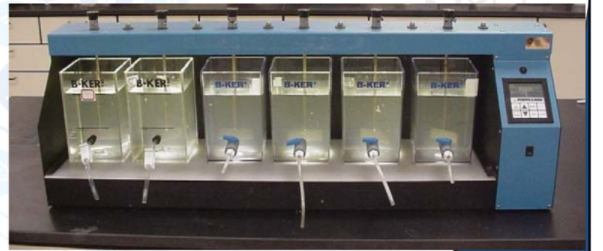
Coagulant Dose Optimization in Laboratory: Jar Test

In practice, irrespective of what coagulant or coagulant aid is used, the optimum dose are usually
determined by a Jar Test. A typical Jar Test apparatus consists of four to six beakers of 1‐2 L volume, provided with a variable‐speed stirrer.

Procedure: 
Beakers filled with the raw water and varying amounts of coagulant dose are administered. The contents are rapidly mixed for about a minute and then allowed to flocculate at a slower pre‐worked speed (usually 20‐30 rpm) for desired time (usually 15‐30 mins). Thereafter, the contents are allowed to settle for desired time (usually 20‐ 40 mins), and the optimum dose is determined based on the measured turbidity of supernatant water (alternatively, judgement may be made based on visual inspection).


Jar test may be used to optimize:
  • pH
  • Mixing Speed for Flocculation
  • Flocculation time

Importance of Optimum Coagulant Dosing Coagulant over‐dosing may leads to
o Increased treatment costs
o Restabilization of colloids
o Increases sludge mass
o Public health concerns

Coagulant under‐dosing may leads
o Lesser degree of removal
o Failure to meet the water quality targets


Friday, 11 March 2022

Traffic Engineering

 Do You Know?

πŸ‘‰Various methods of carrying out Speed and Delay study

   (a) FLOATING CAR or RIDING CHECK METHOD

   (b) LICENSE PLATE or VEHICLE NUMBER METHOD

   (c) INTERVIEW TECHNIQUE

   (d) ELEVATED OBSERVATIONS

   (e) PHOTOGRAPHIC TECHNIQUE

πŸ‘‰Origin and Destination Studies (O & D Data)

Origin and destination studies of vehicles determines their numbers, origin and destination in the concerned zone of study.

πŸ‘‰ Methods of collection of O & D Data)

(a) ROAD SISE INTERVIEW METHOD

(b) LICENSE PLATE METHOD

(c) RETURN POST CARD METHOD

(d) TAG ON CAR METHOD

(e) HOME INTERVIEW METHOD

(f) WORK SPOT INTERVIEW METHOD

πŸ‘‰Representation of O & D Data

(a) O & D Table

(b) Desire Lines

(c) Pie Chart

(d) Contour Lines

Note: Desire lines are straight lines connecting the origin points with destinations.

πŸ‘‰ Accident Studies

Accident studies are used to find out the reason and cause behind accident and to take preventive measures in term of design control.

The various records that are maintained in accident studies are:

(a) Location Files

(b) Spot Maps

(c) Condition Diagram

(d) Collision Diagram

Thursday, 13 January 2022

Highway Engineering

 Do you know?

πŸ‘‰The highway planning surveys consists:

    (i) Economic studies (Population and distribution in each village, trend of population growth, per capita income)

    (ii) Financial studies (Source of income and estimated revenue from taxation on road transport, living standards, future trends in financial aspects)

    (iii) Traffic or road studies (Traffic volume, traffic flow pattern, O and D studies)

    (iv) Engineering studies (Road location and alignment studies, Classification, Types of road in use, Maintenance problems)

πŸ‘‰ The stages of engineering surveys for highway locations are:

   (i) Map study

   (ii) Reconnaissance

   (iii) Preliminary surveys

   (iv) Final location and detailed surveys

πŸ‘‰ The following drawing are usually prepared in a highway project:

(a) Key map (Should show the proposed and existing roads and important places to be connected, the size of the plan should not exceed 22 x 20 cm.)

(b) Index map (Should show the general topography of the area, size being 32 x 20 cm)

(c) Preliminary survey plans (details of various alignment, scale: 10 cm = 1km to 25 cm = 1km)

(d) Detailed plan and longitudinal section 

(e) Detailed cross-section

(f) Land acquisition plans

(g) Drawings of cross drainage and other retaining structures

(h) Drawings of road intersections

(i) Land plans showing quarries

πŸ‘‰ Typical Flexible Pavement Failures:

(a) Alligator (Map) cracking

  • Most common type of failure and occurs due to relative movement of pavement layer materials.
  • caused by repeated application of heavy wheel loads resulting in fatigue failure or due to moisture variations resulting in swelling and shrinkage of subgrade.
                                             

(b) Consolidation of pavement layers
  • Formation of ruts are mainly attributed to the consolidation of pavement layers.

(c) Shear failure and cracking
  • Shear failure causes upheaval of pavement materials by forming  a fracture or cracking.
(d) Longitudinal cracking
  • Due to frost action and differential volume changes in subgrade 
(e) Reflection Cracking
  • observed in bituminous overlays over existing cement concrete pavements
πŸ‘‰Typical Rigid pavement failures:
(a) Scaling of cement concrete:
  • scaling is observed in cc pavement showing overall deterioration of the concrete.
(b) Shrinkage cracks
(c) Spalling of joint
(d) Warping cracks
(e) Mud Pumping
  • Mud pumping is recognized when the soil slurry ejects out through the joints and crack of cc pavements during the downward movement of slab under the heavy wheel load.


Thursday, 6 January 2022

Foundation Engineering

 πŸ‘‰ The Primary objective of soil exploration is:

  • Determination of the nature of the deposits of soil, depth and thickness of various soil strata.
  • Location of Ground water table and obtaining soil and rock samples from the various strata.
  •  The determination of the engineering properties of the soil and rock strata that affect the performance of the structure.
  • Determination of the in-situ properties by performing field
Methods: Test Pits
                 Boring
                 Standard Penetration Test (SPT) [N Value]
                Cone Penetration Test (CPT): Static cone penetration test (SCPT)[qc value]

                 Dynamic cone penetration test (DCPT)

                 Pressuremeter Test (PMT)
                 Dilatometer Test (DMT)
                 Vane Shear Test (VST)
                Geophysical Exploration: Seismic reflection survey
                                                         Seismic refraction survey
                                                         Seismic Cross-hole survey
                                                         Resistivity Survey

              Plate Load Test
              Pile Load Test


πŸ‘‰ Standard Penetration Test (SPT): IS 2131-1981
  • The Standard Penetration Test (SPT) is widely used to determine the parameters of the soil in-situ. The test consists of driving a split-spoon sampler into the soil through a bore hole at the desired depth.
  •  The split-spoon sampler is driven into the soil a distance of 450 mm at the bottom of the boring
  • A hammer of 63.5 kg weight with a free fall of 750 mm is used to drive the sampler.
  • The number of blows for a penetration of last 300 mm is designated as the “Standard Penetration Value” or “Number” N.
  • The test is usually performed in three stages. The blow count is found for every 150 mm penetration.
  • The blows for the first 150 mm are ignored as those required for the seating drive.
  • Number of blows for the first 150 mm penetration is disregarded due to the disturbance likely to exist at the bottom of the drill hole
  • The test can be conducted at every 1m vertical intervals (Not more than 1.5 m)
πŸ‘‰The refusal of test when
• 50 blows are required for any 150 mm increment.
• 100 blows are obtained for required 300 mm penetration.
• 10 successive blows produce no advance.
πŸ‘‰Two corrections due to:
(a) Overburden pressure (granular soil)
(b) Dilatancy (for saturated fine sands and silts)
πŸ‘‰The corrected N value is given by (overburden correction)
                  
                                   N′ = (CF). N

                 where N′ = corrected value of observed N

                CF = correction factor for overburden pressure

πŸ‘‰Dilatancy Correction
                         
                            N′′= 15+0.5(N′-15)       if N′ > 15

Cone Penetration Test (CPT)
There are two types of CPT

(i) Dynamic cone penetration test (DCPT)                 (ii) Static cone penetration test (SCPT)

Static Cone Penetration Test
• The Static cone penetration test, which is also known as Dutch Cone test, has been standardized by “IS: 4968 (Part-III)-1976 - Method for subsurface sounding for soils - Part III Static cone penetration test”.
• The equipment consists of a steel cone, a friction jacket, sounding rod, mantle tube, a driving mechanism and measuring equipment.
• The cone have an apex angle of 60° ± 15′ and overall base diameter of 35.7 mm giving a cross-sectional area of 10 cm2.
  • The friction sleeve should have an area of 150 cm2 as per standard practice.
  • The sounding rod is a steel rod of 15 mm diameter which can be extended with additional rods of 1 m each in length.
  • The driving mechanism should have a capacity of 20 to 30 kN for manually operated equipment and 100 kN for the mechanically operated equipment.

Dynamic Cone Penetration Test
• The dynamic cone penetration test is standardised by “IS: 4968 (Part I) – 1976 - Method for Subsurface Sounding for Soils-Part I Dynamic method using 50 mm cone without bentonite slurry”.
• The equipment consists of a cone, driving rods, driving head, hoisting equipment and a hammer.
• The hammer used for driving the cone shall be of mild steel or cast-iron with a base of mild steel and the weight of the hammer shall be 640 N (65 kg).
• The cone shall be driven into the soil by allowing the hammer to fall freely through 750 mm each time.
• The number of blows for every 100 mm penetration of the cone shall be recorded.
• The process shall be repeated till the cone is driven to the required depth.


Saturday, 1 January 2022

Environmental Engineering

 πŸ‘‰Fluctuations in water demand:

  • In India  the maximum daily demand of water is generally taken as 180% of the annual average daily demand of water ( peak factor = 1.8 ) 
  • In India the maximum hourly demand of water is generally taken as 150 per cent of the hourly demand on the day of maximum use of water ( or the maximum day for the year). [Peak Factor = 1.5]
  • Average Daily per capita Demand = Quantity required in 12 months / (365 x population)
  • Maximum daily demand = 1.8 x average daily demand.
  • Maximum hourly demand of maximum day i.e. Peak demand = 1.5 x average hourly demand on a maximum day

                                                              =     2.7 x annual average hourly demand

πŸ‘‰ Water Quality Parameters

 1.Conductivity or Electrical Conductivity (EC): is the ability of water to carry an electrical current. Pure water is a poor conductor of electricity and water shows significant conductivity when dissolved salts are present (generally, directly proportional to the amount of salts dissolved in the water). It is measured using conductivity sensors, and is expressed as siemens/meter (S/m).

 2.Colour: It is an important from the standpoint of aesthetics. Colour in water is often caused by organic substances such as algae or humic compounds. The colour could be Apparent (caused by suspended matter) or True (caused by dissolved or colloidal solids).

For measurement purpose, the colour produced by 1 mg/L of platinum (as K2PtCl6) and 0.5 mg/L of

cobalt (as CoCl2•6H2O) is taken as the standard one unit of colour, and a sequential dilution method

may be followed to determine the colour in standard colour units. Spectrophotometric determination of colour in the form of absorbance at select wavelength is also getting popular.

2. Odour: in water is objectionable. Pure water is odourless, but water may acquire odour when some

substances are dissolved. Decayed organic substances give fouling smell while inorganic substances

give earthy smell. 

  • Odour is measured through Threshold Odour Test, where dilution factor is determined to make the water odourless.
  • Threshold Odour Numbers (TON) can be computed as:

            = (Volume of Sample + Volume of Pure Water needed to remove any odour)/Volume of Sample

3. Turbidity: is an optical property, describing the clarity, or haziness of the water caused by the presence of very fine suspended or colloidal particles (typically not filterable by routine methods). Turbid waters are unacceptable to consumers. Turbidity may also affect the treatability of waters.

  • Turbidity is measured through passing a beam of light through the sample, and recording its scattering. The quantity of light scattered is dependent upon the concentration and size distribution of the particles.

a) In turbidimetry, the intensity of light transmitted is measured.

b) In nephelometry the intensity of the light scattered at 900 is measured.

4. Hardness: in water is caused by the presence of Ca2+ and Mg2+ ions as Hydrogencarbonate ‐ Ca(HCO3)2, Mg(HCO3)2 ; Sulphates‐ CaSO4, MgSO4 ; Chloride ‐ CaCl2, MgCl2 etc. Bicarbonates of Ca and Mg leads to Temporary Hardness, while sulphates/chlorides/nitrates of Ca and Mg leads to Permanent Hardness.

  • Hardness is most commonly measured by titration with an EDTA solution, however test strips or

instruments separately measuring Ca and Mg are also being used. Hardness can also be collocated

using ion balance where equivalence of Ca2+ and Mg2+ are estimated after converting each ion as mg/L of CaCO3.

5. Solids : refers to the mass of solids present in the water. The Total Solids (TS) mass present in the water could be in suspended or dissolved state, and could be volatile or fixed by nature. Based on these different measures of solids are estimated. The measurements are done using gravimetric analysis.

  • Inorganic salts in water often remains in dissolved state and are non‐volatile even at high temperatures, therefore contributes to Fixed Dissolved Solids (FDS). While, Fixed Suspended Solids (FSS) are inorganic particles suspended in the liquid; such as undissolved salt crystals and silt particles.
  • Organic compounds are often volatile at high temperature. The dissolved organics e.g. sugars, fatty acids etc. constitutes Volatile Dissolved Solids (VDS), while suspended organics and microorganisms constitute Volatile Suspended Solids (VSS).
  • Sum of FDS and VDS forms Total Dissolved Solids (TDS), while sum of VSS and FSS is called Total Suspended Solids (TSS).  

6. Most Probable Number (MPN) : is most commonly applied parameter for microbial quality testing of water. Fecal coliforms act as an indicator for fecal contamination of water.

Friday, 22 October 2021

Geotechnical Engineering

 πŸ‘‰Casagrande apparatus: used to determine liquid limit.

πŸ‘‰ Oedometer is used to find the consolidation characteristic of soil.

πŸ‘‰ Hydrometer is used to determine grain size distribution

πŸ‘‰ Plate load test is used to determine safe bearing capacity of soil.

πŸ‘‰Pycnometer method is the laboratory method for determining specific gravity as well as water content of soil sample

πŸ‘‰Permeameter is used to find hydraulic conductivity and permeability of soil sample.

πŸ‘‰Core cutter is a field method to compute bulk density of soil.

πŸ‘‰ Increasing order of their grain size:

         Montmorillonite < Illite < Kaolinite

πŸ‘‰Sequence of plasticity index

    Montmorillonite > Illite > Kaolinite

πŸ‘‰ Relative compaction: Degree of compaction achieved as a percentage of the laboratory compaction

       Relative compaction = dry density in field/ maximum dry density from the proctor test 

πŸ‘‰Relative density can be zero but relative compaction can never be zero.

πŸ‘‰with increase in temperature, viscosity decreases and permeability increases.

                     k ∝ Unit weight/ Viscosity

πŸ‘‰Effective stress increases, void ratio decreases and permeability decreases.

 πŸ‘‰Organic matter has the tendency to move towards flow channel and choke them, thus reduces permeability

πŸ‘‰ Entrapped air decreases the permeability of soil.


Sunday, 17 October 2021

Engineering Hydrology

 πŸ‘‰ A flow duration curve is a plot of discharge against the percentage of time the flow was equaled or 

exceeded. This curve is also known as discharge frequency curve.  

πŸ‘‰Line joining points of equal rainfall depth is called isohyet.

πŸ‘‰ Isopleths are line on a map through points having equal depth of evapotranspiration.

πŸ‘‰                    Name                       Isopleth of (i.e line joining places of equal)

                        Isotherm                                           Temperature

                         Isobar                                               Pressure
                 
                         Isobath                                             Depth in sea
 
                        Isochrone                                        Travel time from a common centre

                       Isohaline                                              Salinity

                        Isohyets                                                 Rainfall

                        Isonif                                                Snowfall amount

                       Isoryme                                                Frost

                        Isohels                                                Sunshine

πŸ‘‰  Bowen's ratio is defined as the ratio of Sensible heat transfer from water surface to air (Ha) to Heat energy used up in evaporation (He)

πŸ‘‰               Property                                  Measuring Instrument

                  Evapotranspiration                          Lysimeter

                Capillary Potential                            Tensiometer

                Transpiration                                    Phytometer

                 Evaporation                                     Atmometer

                Hydraulic Conductivity                     Permeameter

                Infiltration Capacity                          Infiltrometer

                                                                           Rainfall Simulator

              Humidity                                             Hygrometer

              Relative Humidity                              Psychrometer

              Wind Speed                                        Anemometer

 πŸ‘‰ Ratio of total channel length to the discharge area is called drainage density. 

πŸ‘‰         Hyetograph:  Rainfall intensity versus time 

   
               Mass Curve: Cumulative rainfall versus time


               Hydrograph: hydrograph is a graph showing the rate of flow versus time past a specific point in a river, channel, or conduit carrying flow


Saturday, 16 October 2021

Target GATE & ESE 2022 (Building Materials)

 πŸ‘‰Fine grinding leads to high early strength.

πŸ‘‰ The finer the cement the higher is the rate of hydration which results in early development of strength.

πŸ‘‰Decreasing the lime cement increases the proportion of C2S (Belite) and reduces that of C3S (Alite) and hence leads to slow setting low heat cement.

πŸ‘‰Burning at higher temperature increases the proportion of Alite (C3S) in cement and hence leads to high early strength.

πŸ‘‰Increasing the quantity of gypsum retards setting of cement.

πŸ‘‰Before testing setting time of cement, test for consistency (Normal Consistency) is done to know the water required for preparation of standard paste of normal consistency. Amount of water (0.85 times water used in consistency) is used for preparation of cement paste in setting time test.

πŸ‘‰Low heat cement has a high percentage of dicalcium silicate (C2S) and low percentage of tricalcium silicate (C3S)

πŸ‘‰High early strength portland cement has high percentage of C3S and lower percentage of C2S

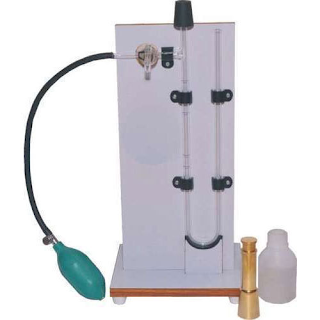
πŸ‘‰Specific gravity of cement (G = 3.14) is determined by Le Chatelier's Flask.

                                                                 Le Chatelier's Flask


πŸ‘‰For checking the soundness( Soundness test is done on cement to determine the expansion of cement due to the presence of free lime and magnesia in the cement) of cement Autoclave test is done.


πŸ‘‰The fineness of cement is determined by Blaine's Air Permeability apparatus.


πŸ‘‰Superplasticizers increases the workability by dispersion of cement particles. It can remove air bubbles . It can also be used to retard setting.

πŸ‘‰Blast furnace slag cement is more resistant to sulphate attack and is specified for marine work or pipe carrying water containing chemicals or sewage.

πŸ‘‰  Different Phase of cement                          Temperature ( in Degree Celsius)

      Formation of C3S                                                               > 1250 
   
       Formation of C2S                                                               900-1200

      Formation of C3A and C4AF                                              Cooling Stage

      Decarbonation of CaCO3                                                     < 900


πŸ‘‰LSF(Lime saturation factor) is a used quality parameter to limit the amount of free lime (CaO)

πŸ‘‰LSF is used a quality parameter to limit the Unsoundness of the cement.         

πŸ‘‰ Crystal Structure of different phases

             C3S ------------------  Irregular Structures, several polymorphs.
         
             C2S--------------------Rounded structures, several polymorphs

             C3A ------------------Cubic in pure form

             C4AF-----------------Series of solid solutions

πŸ‘‰ The decreasing order of heat of hydration of pure cement compounds are:

                 C3A > C3S > C4AF > C2S


Thursday, 14 October 2021

Geomatics Engineering

 πŸ‘‰Actual Distance = (Measured Distance/Nominal length of chain) x Actual length of chain

πŸ‘‰Offsets are lateral measurements made w.r.t main survey line which may be oblique or perpendicular in nature.

πŸ‘‰In aerial photogrametery the photographs are taken at proper interval to provide generally 60% longitudinal overlap and 30 % side overlap.

πŸ‘‰The tape corrections used in Surveying

  • Correction for Standardization (+ or -)
  • Correction for Slope (Always negative)
  • Correction of Pull (+ or -)
  • Correction for Temperature (+ or -)
  • Correction for Sag (Always negative)
  • Normal Tension 
  • Correction for Misalignment (Always negative)
πŸ‘‰ Tape correction for standardization (Csd):

                            Csd = (l'-l)/l x L
where, l = nominal length of tape
          l’ = actual length of tape
          L = measured length
          Csd = Correction for standardization

 πŸ‘‰ Correction for Slope (Cs):


Where,

                    D = horizontal equivalent
                    L = slope distance
            

                        Correction for Slope

     Where,          h = difference in elevations of the end points

                           Cs = correction due to slope


πŸ‘‰ Correction for Pull (Cp):

The correction of pull is computed as

Correction of Pull

Where,
P = pull applied during measurement.
Po = Standard pull
L = Measured length
A = Cross- sectional area of the tape
E = Young’s modulus of material of tape

πŸ‘‰Correction for Temperature (Ct):

The correction for temperature is computed as


Ct = Ξ± (Tm - To) L

where,
Ξ± = coefficient of linear expansion
Tm = Mean temperature of the tape
To  = Standard temperature

πŸ‘‰ Sag Correction (Csg):

  • A tape is supported at two ends, it takes the shape of a CATENARY. 
  • The correction for sag should be applied as the horizontal chord Length is always shorter than the curved length

Where,
W = Weight of tape per unit length.
P = Applied pull.
l1 = length of the tape suspended between the supports.

The above equation can also be written in the form of total weight of tape

where,
W = total weight of tape between the supports

πŸ‘‰ Normal Tension:

The normal tension is a tension at which the effects of pull and sag are neutralized.


πŸ‘‰Correction for Misalignment (Cm):

  •  If L1 = L2 then Cm = d² / L (Negative)
πŸ‘‰Optical square is used to establish two points at right angle. The principle used is double reflection.
πŸ‘‰Method commonly used in Reconnaissance surveying for measurement of horizontal distance are PACING, PASSOMETER, PEDOMETER, ODOMETER,MEASURING WHEEL, SPEEDOMETER,PERAMBULATOR.

πŸ‘‰Equation of cubic parabola  = X^3/6RL

πŸ‘‰Shift in Transition Curve = L^2/24R