Thursday, 13 January 2022

Highway Engineering

 Do you know?

👉The highway planning surveys consists:

    (i) Economic studies (Population and distribution in each village, trend of population growth, per capita income)

    (ii) Financial studies (Source of income and estimated revenue from taxation on road transport, living standards, future trends in financial aspects)

    (iii) Traffic or road studies (Traffic volume, traffic flow pattern, O and D studies)

    (iv) Engineering studies (Road location and alignment studies, Classification, Types of road in use, Maintenance problems)

👉 The stages of engineering surveys for highway locations are:

   (i) Map study

   (ii) Reconnaissance

   (iii) Preliminary surveys

   (iv) Final location and detailed surveys

👉 The following drawing are usually prepared in a highway project:

(a) Key map (Should show the proposed and existing roads and important places to be connected, the size of the plan should not exceed 22 x 20 cm.)

(b) Index map (Should show the general topography of the area, size being 32 x 20 cm)

(c) Preliminary survey plans (details of various alignment, scale: 10 cm = 1km to 25 cm = 1km)

(d) Detailed plan and longitudinal section 

(e) Detailed cross-section

(f) Land acquisition plans

(g) Drawings of cross drainage and other retaining structures

(h) Drawings of road intersections

(i) Land plans showing quarries

👉 Typical Flexible Pavement Failures:

(a) Alligator (Map) cracking

  • Most common type of failure and occurs due to relative movement of pavement layer materials.
  • caused by repeated application of heavy wheel loads resulting in fatigue failure or due to moisture variations resulting in swelling and shrinkage of subgrade.
                                             

(b) Consolidation of pavement layers
  • Formation of ruts are mainly attributed to the consolidation of pavement layers.

(c) Shear failure and cracking
  • Shear failure causes upheaval of pavement materials by forming  a fracture or cracking.
(d) Longitudinal cracking
  • Due to frost action and differential volume changes in subgrade 
(e) Reflection Cracking
  • observed in bituminous overlays over existing cement concrete pavements
👉Typical Rigid pavement failures:
(a) Scaling of cement concrete:
  • scaling is observed in cc pavement showing overall deterioration of the concrete.
(b) Shrinkage cracks
(c) Spalling of joint
(d) Warping cracks
(e) Mud Pumping
  • Mud pumping is recognized when the soil slurry ejects out through the joints and crack of cc pavements during the downward movement of slab under the heavy wheel load.


Thursday, 6 January 2022

Foundation Engineering

 👉 The Primary objective of soil exploration is:

  • Determination of the nature of the deposits of soil, depth and thickness of various soil strata.
  • Location of Ground water table and obtaining soil and rock samples from the various strata.
  •  The determination of the engineering properties of the soil and rock strata that affect the performance of the structure.
  • Determination of the in-situ properties by performing field
Methods: Test Pits
                 Boring
                 Standard Penetration Test (SPT) [N Value]
                Cone Penetration Test (CPT): Static cone penetration test (SCPT)[qc value]

                 Dynamic cone penetration test (DCPT)

                 Pressuremeter Test (PMT)
                 Dilatometer Test (DMT)
                 Vane Shear Test (VST)
                Geophysical Exploration: Seismic reflection survey
                                                         Seismic refraction survey
                                                         Seismic Cross-hole survey
                                                         Resistivity Survey

              Plate Load Test
              Pile Load Test


👉 Standard Penetration Test (SPT): IS 2131-1981
  • The Standard Penetration Test (SPT) is widely used to determine the parameters of the soil in-situ. The test consists of driving a split-spoon sampler into the soil through a bore hole at the desired depth.
  •  The split-spoon sampler is driven into the soil a distance of 450 mm at the bottom of the boring
  • A hammer of 63.5 kg weight with a free fall of 750 mm is used to drive the sampler.
  • The number of blows for a penetration of last 300 mm is designated as the “Standard Penetration Value” or “Number” N.
  • The test is usually performed in three stages. The blow count is found for every 150 mm penetration.
  • The blows for the first 150 mm are ignored as those required for the seating drive.
  • Number of blows for the first 150 mm penetration is disregarded due to the disturbance likely to exist at the bottom of the drill hole
  • The test can be conducted at every 1m vertical intervals (Not more than 1.5 m)
👉The refusal of test when
• 50 blows are required for any 150 mm increment.
• 100 blows are obtained for required 300 mm penetration.
• 10 successive blows produce no advance.
👉Two corrections due to:
(a) Overburden pressure (granular soil)
(b) Dilatancy (for saturated fine sands and silts)
👉The corrected N value is given by (overburden correction)
                  
                                   N′ = (CF). N

                 where N′ = corrected value of observed N

                CF = correction factor for overburden pressure

👉Dilatancy Correction
                         
                            N′′= 15+0.5(N′-15)       if N′ > 15

Cone Penetration Test (CPT)
There are two types of CPT

(i) Dynamic cone penetration test (DCPT)                 (ii) Static cone penetration test (SCPT)

Static Cone Penetration Test
• The Static cone penetration test, which is also known as Dutch Cone test, has been standardized by “IS: 4968 (Part-III)-1976 - Method for subsurface sounding for soils - Part III Static cone penetration test”.
• The equipment consists of a steel cone, a friction jacket, sounding rod, mantle tube, a driving mechanism and measuring equipment.
• The cone have an apex angle of 60° ± 15′ and overall base diameter of 35.7 mm giving a cross-sectional area of 10 cm2.
  • The friction sleeve should have an area of 150 cm2 as per standard practice.
  • The sounding rod is a steel rod of 15 mm diameter which can be extended with additional rods of 1 m each in length.
  • The driving mechanism should have a capacity of 20 to 30 kN for manually operated equipment and 100 kN for the mechanically operated equipment.

Dynamic Cone Penetration Test
• The dynamic cone penetration test is standardised by “IS: 4968 (Part I) – 1976 - Method for Subsurface Sounding for Soils-Part I Dynamic method using 50 mm cone without bentonite slurry”.
• The equipment consists of a cone, driving rods, driving head, hoisting equipment and a hammer.
• The hammer used for driving the cone shall be of mild steel or cast-iron with a base of mild steel and the weight of the hammer shall be 640 N (65 kg).
• The cone shall be driven into the soil by allowing the hammer to fall freely through 750 mm each time.
• The number of blows for every 100 mm penetration of the cone shall be recorded.
• The process shall be repeated till the cone is driven to the required depth.


Saturday, 1 January 2022

Environmental Engineering

 👉Fluctuations in water demand:

  • In India  the maximum daily demand of water is generally taken as 180% of the annual average daily demand of water ( peak factor = 1.8 ) 
  • In India the maximum hourly demand of water is generally taken as 150 per cent of the hourly demand on the day of maximum use of water ( or the maximum day for the year). [Peak Factor = 1.5]
  • Average Daily per capita Demand = Quantity required in 12 months / (365 x population)
  • Maximum daily demand = 1.8 x average daily demand.
  • Maximum hourly demand of maximum day i.e. Peak demand = 1.5 x average hourly demand on a maximum day

                                                              =     2.7 x annual average hourly demand

👉 Water Quality Parameters

 1.Conductivity or Electrical Conductivity (EC): is the ability of water to carry an electrical current. Pure water is a poor conductor of electricity and water shows significant conductivity when dissolved salts are present (generally, directly proportional to the amount of salts dissolved in the water). It is measured using conductivity sensors, and is expressed as siemens/meter (S/m).

 2.Colour: It is an important from the standpoint of aesthetics. Colour in water is often caused by organic substances such as algae or humic compounds. The colour could be Apparent (caused by suspended matter) or True (caused by dissolved or colloidal solids).

For measurement purpose, the colour produced by 1 mg/L of platinum (as K2PtCl6) and 0.5 mg/L of

cobalt (as CoCl2•6H2O) is taken as the standard one unit of colour, and a sequential dilution method

may be followed to determine the colour in standard colour units. Spectrophotometric determination of colour in the form of absorbance at select wavelength is also getting popular.

2. Odour: in water is objectionable. Pure water is odourless, but water may acquire odour when some

substances are dissolved. Decayed organic substances give fouling smell while inorganic substances

give earthy smell. 

  • Odour is measured through Threshold Odour Test, where dilution factor is determined to make the water odourless.
  • Threshold Odour Numbers (TON) can be computed as:

            = (Volume of Sample + Volume of Pure Water needed to remove any odour)/Volume of Sample

3. Turbidity: is an optical property, describing the clarity, or haziness of the water caused by the presence of very fine suspended or colloidal particles (typically not filterable by routine methods). Turbid waters are unacceptable to consumers. Turbidity may also affect the treatability of waters.

  • Turbidity is measured through passing a beam of light through the sample, and recording its scattering. The quantity of light scattered is dependent upon the concentration and size distribution of the particles.

a) In turbidimetry, the intensity of light transmitted is measured.

b) In nephelometry the intensity of the light scattered at 900 is measured.

4. Hardness: in water is caused by the presence of Ca2+ and Mg2+ ions as Hydrogencarbonate ‐ Ca(HCO3)2, Mg(HCO3)2 ; Sulphates‐ CaSO4, MgSO4 ; Chloride ‐ CaCl2, MgCl2 etc. Bicarbonates of Ca and Mg leads to Temporary Hardness, while sulphates/chlorides/nitrates of Ca and Mg leads to Permanent Hardness.

  • Hardness is most commonly measured by titration with an EDTA solution, however test strips or

instruments separately measuring Ca and Mg are also being used. Hardness can also be collocated

using ion balance where equivalence of Ca2+ and Mg2+ are estimated after converting each ion as mg/L of CaCO3.

5. Solids : refers to the mass of solids present in the water. The Total Solids (TS) mass present in the water could be in suspended or dissolved state, and could be volatile or fixed by nature. Based on these different measures of solids are estimated. The measurements are done using gravimetric analysis.

  • Inorganic salts in water often remains in dissolved state and are non‐volatile even at high temperatures, therefore contributes to Fixed Dissolved Solids (FDS). While, Fixed Suspended Solids (FSS) are inorganic particles suspended in the liquid; such as undissolved salt crystals and silt particles.
  • Organic compounds are often volatile at high temperature. The dissolved organics e.g. sugars, fatty acids etc. constitutes Volatile Dissolved Solids (VDS), while suspended organics and microorganisms constitute Volatile Suspended Solids (VSS).
  • Sum of FDS and VDS forms Total Dissolved Solids (TDS), while sum of VSS and FSS is called Total Suspended Solids (TSS).  

6. Most Probable Number (MPN) : is most commonly applied parameter for microbial quality testing of water. Fecal coliforms act as an indicator for fecal contamination of water.

Friday, 22 October 2021

Geotechnical Engineering

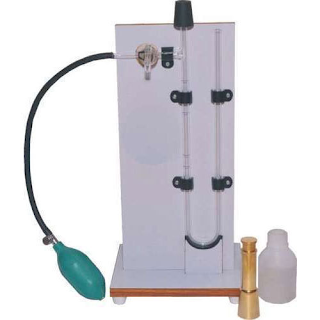
 👉Casagrande apparatus: used to determine liquid limit.

👉 Oedometer is used to find the consolidation characteristic of soil.

👉 Hydrometer is used to determine grain size distribution

👉 Plate load test is used to determine safe bearing capacity of soil.

👉Pycnometer method is the laboratory method for determining specific gravity as well as water content of soil sample

👉Permeameter is used to find hydraulic conductivity and permeability of soil sample.

👉Core cutter is a field method to compute bulk density of soil.

👉 Increasing order of their grain size:

         Montmorillonite < Illite < Kaolinite

👉Sequence of plasticity index

    Montmorillonite > Illite > Kaolinite

👉 Relative compaction: Degree of compaction achieved as a percentage of the laboratory compaction

       Relative compaction = dry density in field/ maximum dry density from the proctor test 

👉Relative density can be zero but relative compaction can never be zero.

👉with increase in temperature, viscosity decreases and permeability increases.

                     k ∝ Unit weight/ Viscosity

👉Effective stress increases, void ratio decreases and permeability decreases.

 👉Organic matter has the tendency to move towards flow channel and choke them, thus reduces permeability

👉 Entrapped air decreases the permeability of soil.


Sunday, 17 October 2021

Engineering Hydrology

 👉 A flow duration curve is a plot of discharge against the percentage of time the flow was equaled or 

exceeded. This curve is also known as discharge frequency curve.  

👉Line joining points of equal rainfall depth is called isohyet.

👉 Isopleths are line on a map through points having equal depth of evapotranspiration.

👉                    Name                       Isopleth of (i.e line joining places of equal)

                        Isotherm                                           Temperature

                         Isobar                                               Pressure
                 
                         Isobath                                             Depth in sea
 
                        Isochrone                                        Travel time from a common centre

                       Isohaline                                              Salinity

                        Isohyets                                                 Rainfall

                        Isonif                                                Snowfall amount

                       Isoryme                                                Frost

                        Isohels                                                Sunshine

👉  Bowen's ratio is defined as the ratio of Sensible heat transfer from water surface to air (Ha) to Heat energy used up in evaporation (He)

👉               Property                                  Measuring Instrument

                  Evapotranspiration                          Lysimeter

                Capillary Potential                            Tensiometer

                Transpiration                                    Phytometer

                 Evaporation                                     Atmometer

                Hydraulic Conductivity                     Permeameter

                Infiltration Capacity                          Infiltrometer

                                                                           Rainfall Simulator

              Humidity                                             Hygrometer

              Relative Humidity                              Psychrometer

              Wind Speed                                        Anemometer

 👉 Ratio of total channel length to the discharge area is called drainage density. 

👉         Hyetograph:  Rainfall intensity versus time 

   
               Mass Curve: Cumulative rainfall versus time


               Hydrograph: A hydrograph is a graph showing the rate of flow versus time past a specific point in a river, channel, or conduit carrying flow


Saturday, 16 October 2021

Target GATE & ESE 2022 (Building Materials)

 👉Fine grinding leads to high early strength.

👉 The finer the cement the higher is the rate of hydration which results in early development of strength.

👉Decreasing the lime cement increases the proportion of C2S (Belite) and reduces that of C3S (Alite) and hence leads to slow setting low heat cement.

👉Burning at higher temperature increases the proportion of Alite (C3S) in cement and hence leads to high early strength.

👉Increasing the quantity of gypsum retards setting of cement.

👉Before testing setting time of cement, test for consistency (Normal Consistency) is done to know the water required for preparation of standard paste of normal consistency. Amount of water (0.85 times water used in consistency) is used for preparation of cement paste in setting time test.

👉Low heat cement has a high percentage of dicalcium silicate (C2S) and low percentage of tricalcium silicate (C3S)

👉High early strength portland cement has high percentage of C3S and lower percentage of C2S

👉Specific gravity of cement (G = 3.14) is determined by Le Chatelier's Flask.

                                                                 Le Chatelier's Flask


👉For checking the soundness( Soundness test is done on cement to determine the expansion of cement due to the presence of free lime and magnesia in the cement) of cement Autoclave test is done.


👉The fineness of cement is determined by Blaine's Air Permeability apparatus.


👉Superplasticizers increases the workability by dispersion of cement particles. It can remove air bubbles . It can also be used to retard setting.

👉Blast furnace slag cement is more resistant to sulphate attack and is specified for marine work or pipe carrying water containing chemicals or sewage.

👉  Different Phase of cement                          Temperature ( in Degree Celsius)

      Formation of C3S                                                               > 1250 
   
       Formation of C2S                                                               900-1200

      Formation of C3A and C4AF                                              Cooling Stage

      Decarbonation of CaCO3                                                     < 900


👉LSF(Lime saturation factor) is a used quality parameter to limit the amount of free lime (CaO)

👉LSF is used a quality parameter to limit the Unsoundness of the cement.         

👉 Crystal Structure of different phases

             C3S ------------------  Irregular Structures, several polymorphs.
         
             C2S--------------------Rounded structures, several polymorphs

             C3A ------------------Cubic in pure form

             C4AF-----------------Series of solid solutions

👉 The decreasing order of heat of hydration of pure cement compounds are:

                 C3A > C3S > C4AF > C2S


Thursday, 14 October 2021

Geomatics Engineering

 👉Actual Distance = (Measured Distance/Nominal length of chain) x Actual length of chain

👉Offsets are lateral measurements made w.r.t main survey line which may be oblique or perpendicular in nature.

👉In aerial photogrametery the photographs are taken at proper interval to provide generally 60% longitudinal overlap and 30 % side overlap.

👉The tape corrections used in Surveying

  • Correction for Standardization (+ or -)
  • Correction for Slope (Always negative)
  • Correction of Pull (+ or -)
  • Correction for Temperature (+ or -)
  • Correction for Sag (Always negative)
  • Normal Tension 
  • Correction for Misalignment (Always negative)
👉 Tape correction for standardization (Csd):

                            Csd = (l'-l)/l x L
where, l = nominal length of tape
          l’ = actual length of tape
          L = measured length
          Csd = Correction for standardization

 👉 Correction for Slope (Cs):


Where,

                    D = horizontal equivalent
                    L = slope distance
            

                        Correction for Slope

     Where,          h = difference in elevations of the end points

                           Cs = correction due to slope


👉 Correction for Pull (Cp):

The correction of pull is computed as

Correction of Pull

Where,
P = pull applied during measurement.
Po = Standard pull
L = Measured length
A = Cross- sectional area of the tape
E = Young’s modulus of material of tape

👉Correction for Temperature (Ct):

The correction for temperature is computed as


Ct = α (Tm - To) L

where,
α = coefficient of linear expansion
Tm = Mean temperature of the tape
To  = Standard temperature

👉 Sag Correction (Csg):

  • A tape is supported at two ends, it takes the shape of a CATENARY. 
  • The correction for sag should be applied as the horizontal chord Length is always shorter than the curved length

Where,
W = Weight of tape per unit length.
P = Applied pull.
l1 = length of the tape suspended between the supports.

The above equation can also be written in the form of total weight of tape

where,
W = total weight of tape between the supports

👉 Normal Tension:

The normal tension is a tension at which the effects of pull and sag are neutralized.


👉Correction for Misalignment (Cm):

  •  If L1 = L2 then Cm = d² / L (Negative)
👉Optical square is used to establish two points at right angle. The principle used is double reflection.
👉Method commonly used in Reconnaissance surveying for measurement of horizontal distance are PACING, PASSOMETER, PEDOMETER, ODOMETER,MEASURING WHEEL, SPEEDOMETER,PERAMBULATOR.

👉Equation of cubic parabola  = X^3/6RL

👉Shift in Transition Curve = L^2/24R


Tuesday, 12 October 2021

Environmental Engineering

 👉Typical range of Hydraulic Conductivity are as follows:

   Soil classification of an aquifer      Hydraulic Conductivity (m/day)          Drainage Characteristics 

         Gravel                                            100-1000                                                Pervious

          Sand                                               1-10                                                      Pervious

         Silt                                                  0.1-0.01                                                 Slightly Pervious

        Clay                                                 10^-5 to 10^-6                                      Impervious

👉 Components of Water Demand:

     Domestic Demand     :         135 lpcd (litre per capita per day)

    Public Demand           :         20 lpcd

  Industrial Demand        :         50 lpcd

  Commercial Demand   :         20 lpcd

       Fire Demand           :          15 lpcd

      Loss and waste         :          50 lpcd 

       Total =  270 lpcd

👉Fire Fighting Water Demand


👉 Fire Fighting Water Demand Empirical Formulae:

  • Buston's Formula
  • Kuichling's Formula
  • Freeman's Formula
  • National Board of Fire Underwriter's Formula


👉 Population Forecasting Methods:
  • Arithmetic Increase Method
  •  Geometric Increase Method
  •  Incremental Increase Method
  •  Logistic Curve Method
  •  Growth Composition Analysis Method
  •  Master Plan Method
  •  Decreasing Rate of Growth Method
  •  Simple Graphical Method
  •  Comparative Graphical Method
  •  Ratio Method

Sunday, 10 October 2021

Solid Mechanics

 👉Plane having principal stress has no tangential stress.

👉Mutually perpendicular planes are 180 degree apart in Mohr circle and have numerically equal value of shear stress.

👉Maximum shear stress = radius of Mohr's circle

👉         Theory of Failure                                               Also Known as  

       Maximum principal stress theory             Rankine theory, Lame's theory, Maximum stress theory

        Maximum principal strain theory                             St. Venant theory

           Maximum shear stress theory                   Tresca theory, Guest theory, Columb theory

          Maximum strain energy theory                              Beltrami Haigh theory

      Maximum shear strain energy theory                 Distortion energy theory, Von-Mises theory

👉 Bending Equation 

                                  M/I = σ/y  = E/R

where, M = Bending Moment

           σ  = Bending stress

           I =  Moment of inertia

          y = Distance of the fibre from Neutral axis

         R = Radius of curvature

         E = young's modulus of elasticity

👉 Torsion Equation:

                      T/Ip = τ/r = τmax/R  = N.θ/l

👉 Strain energy per unit volume = 1/2 x shear stress x shear strain

👉 Strain energy in torsion = 1/2 x T x θ

👉  For Brittle materials, Normal stress theory gives best result

👉 For ductile material maximum shear stress theory is applicable.


                                                                Happy Learning

Tuesday, 5 October 2021

Design of Steel Structure

 👉 Steel's modulus of elasticity is about 3 times that of Aluminium.

👉 Coefficient of thermal expansion for aluminium is about twice that for steel.

👉 Aluminium requires less maintenance than steel as steel prone to rusting

👉Strength to unit weight ratio of aluminium is higher than that for steel.

👉As per IS 800-1984 Cl 9.1.3 members subjected to heavy impact and fatigue shall not be designed on basis of plasticity theory, as it makes full use of materials strength beyond elastic limit.

👉 Truss carries axial load and that can cause shortening.

👉Beam carries force by bending.

👉Column resist force as axial load which can cause buckling of column.

👉Shaft carries force by twisting.

👉According to IS 800-1984 Following are the limits for slenderness ratios

  • For compression member carrying dead and super imposed loads =180
  • For members carrying compressive loads due to wind or seismic forces only =250
  • For members carrying tension but in which the reversal of stress occurs due to wind and seismic forces = 350
👉Permissible axial tensile strength = 0.60 fy

👉Permissible shear stress = 0.45 fy

👉Permissible bearing stress = 0.75 fy

👉Permissible stress in slab base = 185 MPa for all steels

👉Allowable maximum average shear stress = 0.40 fy.


                                                            HAPPY LEARNING


Engineering Hydrology

 👉The hydrological budget equation is:

                          P-R-E-T-G = △S

Where, P = total precipitation

             R = Net runoff = R2-R1 = surface runoff flow- surface runoff inflow

            E = Total evaporation

            T = total Transpiration

          G = Net ground water flow

         △S = Total storage increase

 👉 Hydrological cycle is the cycle in which water is transported from the oceans to the atmosphere as vapours, from the atmosphere to the land as precipitation and back from land to oceans as runoff.   

👉Drizzle:  A fine sprinkle of numerous water droplets of size less than 0.5 mm and intensity less than 1 mm/h

Rain: The precipitation of liquid water with drops of sizes larger than 0.5 mm 

Hail: It is showery precipitation in the form of irregular pellets or lumps of ice of size more than 5 mm.

👉 Average rainfall over a catchment area can be estimated as

1. Arithmetic mean method: 

  • every rain gauge station is given equal weightage regardless of its location.
  • Rainfall is almost uniformly distributed over the whole catchment area which rarely occurs in nature.
  • method is fast but does not give accurate results.
2. Theissen polygon method: 

  • In this method weightage to the various rainfall datas based on area close to the rain gauge station 
  • Method is fast when once the weights are known
  • It does not take care of the variability in rainfall due to elevation difference(topographical influence are not take care of)
  • New polygon is required to be drawn when due to addition or deletion of raingauges to the network, weight of each station changes.
3. Isohyetal method :

  • This is most accurate method
  • It utilizes all relevant data's and properly interpret them.
  • method is slow and laborious
4. Normal ratio method: 

  • It is used to estimate missing rainfall data.

Wednesday, 29 September 2021

Geotechnical Engineering

 👉 Active earth pressure in loose state is larger than the active earth pressure in dense state.

👉 Passive earth pressure in dense state is larger than the passive earth pressure in loose state.

👉 By compacting the soil, active earth pressure decreases but passive earth pressure increases.

👉Soils deposited by wind are called Aeolian soil.

👉All types of soils carried and deposited by water are known as Alluvial deposits.

👉Lacustrine soils are soil deposited in lake beds.

👉Marine deposits are formed when the flowing water carries soils to oceans or sea.

👉Loess is a loose deposit of wind blown silt that has been weakly cemented with calcium carbonate and montmorillonite.

👉Marl is a very fine grained calcium carbonated soil of marine origin.

👉Peat is a highly organic soil, consisting almost entirely of vegetative matter in varying states of decomposition, brown to black in colour, possessing an organic odour.

👉Peat and Muck are organic clay.

👉Volume of solids will remain same in fill and borrow pit.

👉For a sandy soil with soil grains spherical in shape and uniform in size the theoretical void ratio is 0.91.


Thursday, 5 August 2021

Target GATE & ESE 2022 (Strength of Material)

 👉Elongation in prismatic bar 

                        △ = ү.L^2/2E

                        △ = WL/2AE

Here, △ = elongation in prismatic bar

           L = length of bar

           W = self weight of the bar = ρ.A.L

          E = young's modulus of elasticity

          ү = Unit weight of material

👉 Elongation in conical bar

               ∆ = ү.L^2/6E

👉 Elongation in conical bar due to self weight is one third of elongation in prismatic bar due to self weight. 

👉 Important Relationship

    E = 2N (1+μ)

   E = 3K(1-2μ)

   μ = (3K-2N)/(6K+2N)

   E = 9KN/3K+N

where,

        N = Modulus of rigidity/Shear Modulus

        K = bulk modulus

        E = Modulus of elasticity/ Elastic modulus

        µ = Poisson's ratio ( 0 to 0.50)

👉   Modulus of Resilience is energy stored upto elastic limit per unit volume.

👉       △Sudden = 2.△static

👉 strain is the fundamental behaviour but stress is a derived concept because strain can measured with some instrument  and is a fundamental quantity however stress can only be derived , it can not be measured.

👉 If loading of nth degree, then shear force diagram is of (n+1) degree and bending moment diagram  is of (n+2) degree

👉For bending moment M to be maximum

     dM/dx =0 and we know dM/dx  = Shear force (V)

    Bending moment is maximum at the section where shear force is zero or changes sign.

👉        dM/dx = V       (Slope of Bending moment = shear force)

             dV/dx  = w        (Slope of shear force = loading intensity)

             M = ∫ V dx

             V  = ∫ w dx

             d2M/dx2 = dV/dx  = w

   M = Bending moment

   V = shear force

   w = loading intensity

 👉Point of contra-flexure is the point where bending moment changes it's sign

👉        Real Beam             Conjugate Beam

        Hinged Support              Hinged Support

        Free Support                  Fixed support

        Fixed support                  Free support

        Internal roller                  Internal hinge

        Internal hinge                  Internal roller


                                                Happy Learning

                             
                                  Please follow me on talktorashid.blogspot.com

JAM 2022 Notification


UPSC Examinations 2021


GATE 2022 Question Paper Pattern


GATE 2022 Notification


Wednesday, 4 August 2021

Target GATE & ESE 2022 (Geomatics Engineering)

 👉The correct sequence of the survey is

    (a) Traffic survey

    (b) Reconnaissance survey

    (c) Preliminary survey

    (d) Detailed survey or location survey

👉Topographical survey is done to determine information about man made and natural features on earth surface including their elevations.

👉Reconnaissance survey is a kind preliminary survey which is performed to find out method of survey to be adopted and its rough cost.

👉Cadastral survey is done to establish property boundaries.

👉Archaeological survey is done to collect information about old and relic structures.

👉 Transverse surveying is done with the help of compass and chain.

👉Geodetic surveying (Curvature of earth is taken into account) is done with the help of precise instruments such as Theodolite 

👉Weddle sounding machine is used to determine depth of sea in hydrographic surveying.

👉The principal of surveying is work from whole to part.

👉 Various instruments used in surveying and their purpose:

  • Pegs: To mark survey station and end points of survey lines on the ground
  • Ranging Rod: For locating a number of points on a long survey line
  • Offset rods: To set out offset line at right angles
  • Prism Square: Setting out right angles
  • Clinometer: To measure the slope of ground
  • Optical Square: To set out right angles
  • Prismatic Square: Advanced version of Optical Square and used to set out right angles
  • French Cross Staff: Used to set out either 45 degree or 90 degree
  • Open Cross Staff: Type of cross staff which is also used to set out 90 degree
  • Theodolite: To measure of all horizontal and vertical angles
  • Dumpy Level: Measurement of angle and elevation
  • Auto Level: For Levelling purpose

                                                                    Fig 1.  Optical Square


                                                              Fig.2 French Cross Staff
👉Offsets are lateral measurement made w.r.t main survey line which may be oblique or perpendicular in nature.

👉The main objectives of cross staff survey is:
  • To locate boundaries of an area
  • To plot the figure to a scale
  • To find area of the piece of land to be surveyed.  
👉Methods commonly used in reconnaissance surveying for measurement of horizontal distance are:
  • Pacing
  • Passometer
  • Pedometer
  • Odometer
  • Measuring wheel
  • Speedometer
  • Perambulator

                                                                  Fig 3. Passometer


 Fig 4. Pedometer


Happy Learning

Please follow me on talktorashid.blogspot.com